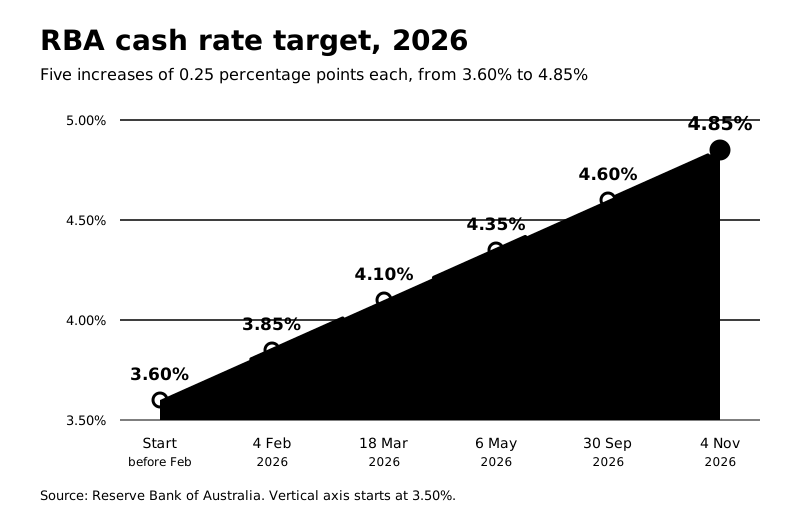
On Cup Day, 3 November, the Reserve Bank lifted the cash rate by 0.25 percentage points to 4.85 per cent. It’s the fifth rise this year, and the highest the rate has been since late 2008. If your stomach dropped a little when you read that, you’re in good company.
So what should we make of it? Honestly, there’s no tidy answer (and anyone who offers you one is probably guessing). There is a sensible way to think it through, though, and it starts with understanding what’s actually going on.
Where we’ve come from
The cash rate started the year at 3.60 per cent. Five increases of 0.25 percentage points later, it’s sitting at 4.85. That’s a climb of 1.25 percentage points in less than twelve months, which is a lot to absorb if you’ve got a loan.
The latest decision wasn’t unanimous either. Six members of the Reserve Bank’s Monetary Policy Board voted to lift the rate, while three wanted to hold. We find that split quite telling. Even the people making the call seem to be weighing it carefully.
Why the Reserve Bank is doing it
In a word, inflation. The Board describes it as elevated and broadly based, and says higher fuel and commodity prices linked to the Middle East conflict haven’t helped. Its latest forecasts have inflation staying above 3 per cent over the coming year, and not reaching the top of its 2 to 3 per cent target range until late 2027 – roughly three quarters later than it expected before.
Here’s where it gets uncomfortable. The economy is slowing. House prices have fallen significantly this year, and unemployment has risen to 4.7 per cent, with the Reserve Bank expecting it to climb further. Governor Michele Bullock has said the bank isn’t trying to tip the economy into recession if it can avoid it, but that inflation has to come down. Raising rates into a slowdown is a genuinely hard balancing act, and we don’t envy anyone doing it.
What it can mean at home
For anyone with a variable-rate home loan, the effect is fairly direct. Banks tend to pass rises on quickly. ABC reporting earlier this year estimated that each 0.25 percentage point adds roughly $91 a month to a $600,000 loan with 25 years to run. Stack five of those together and you’re somewhere near $450 a month (that’s our rough arithmetic, so please don’t treat it as gospel for your own loan).
If you’re on a fixed rate, nothing changes today. The catch is that when your fixed term ends, the loan usually rolls onto a variable rate, and the full effect of the rises arrives all at once. It’s worth knowing when that date is.
Savers are the other side of the coin. Savings and term deposit rates generally rise after a hike, so you may earn more on cash, provided your bank passes the increase on. And if you’re planning to buy, higher rates reduce how much lenders will let you borrow, which can quietly reshape your options.
What about investors and retirees?
It depends, as it so often does. Higher rates make investment debt more expensive to carry. In general, interest on money borrowed to invest may be tax-deductible, while interest on a home loan usually isn’t, which is why the structure of your debt matters as much as the size of it. For people living off the income from their assets, better returns on cash can help, but share and property values can move around too. None of this is simple, and it sounds a bit complicated because it is.
What happens next?
Nobody knows, and that’s not a cop-out. Economists are split. One has suggested another rise in February is his base case, while another expects the Reserve Bank to wait and see over summer. The bank itself says changes in the cash rate take 12 to 18 months to flow through the economy, so the full impact may not be clear until 2028.
We can’t control the weather, but we can check the roof. That’s really the point.
Questions worth asking yourself
We’re not going to hand out personal recommendations on a web page. Everyone’s situation is different, and that’s rather the point of sitting down together. What we can do is suggest some questions that tend to be useful.
Do you know exactly what your repayments are today, and what they’d look like another percentage point higher? When does your fixed term finish? Do you have an emergency fund that could carry you through a rough few months? Is your debt structured in a way that suits your goals, including the difference between deductible and non-deductible debt? And is your superannuation and investment strategy built for the long haul rather than this week’s headlines?
If a few of those made you pause, that’s useful information. It doesn’t mean something’s wrong. It just means a conversation might be worthwhile.
How we can help
Rate rises come and go, and we know everyone’s situation changes from time to time. A personalised Financial Advisory Masterplan is designed to keep working through all of it, whether that means looking at debt management, superannuation, protection for you and your family, or your plans for retirement.
Your first appointment is obligation-free. Our advice is fee-for-service, with fees agreed upfront based on the scope of advice you need. No surprises.
Start your financial journey with BA Wealth
You don’t need to have it all worked out. Start taking small steps today by booking in for an obligation-free, online appointment without leaving your home. Together, we’ll create a personalised plan to help you work toward lasting financial success!
The information provided in this article is general advice only. It does not take into account your personal objectives, financial situation or needs, and it is not personal advice. Before acting on any information, please consider whether it is appropriate for you and speak with an adviser. Examples are illustrative only and individual outcomes depend on your loan type, balance, remaining term and lender.